Tuesday, October 9, 2007
just a note

Sunday, October 7, 2007
Why Does Trig Work? [10/2/07]
 Why Does Trig Work?
Triangle Problem:
1.Draw a Trianlge
2.Measure easch side to the nearest 10th of a centimenter
3.Solve for:
AB/AC BC/AC AB/BC
Class Results:
-The actual results are AB/AC = .8192 BC/AC = .5736 AB/BC = 1.4281
It is important to recognize that the ration is constant and that similarity is why trig works
Bearing:

Right Triangle Trig:
SOH CAH TOA :
sin: opp/hyp cos: adj/hyp tan: opp/adj
Reciprocal relationships:
csc: hyp/opp or 1/sin of angle sec: hyp/adj or 1/cos of angle
cot: adj/opp or 1/tan of angle
Ex. :
The sine of an angle equals 5/6 Find values of all 6 trig functions.

Start by using the pythagorean theorem

180 - 143 = 37
Angle of Depression
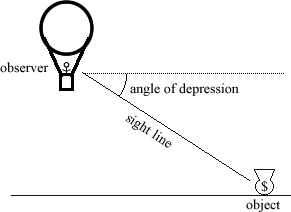
30-60-90 Triangle

45-45-90 Triangle

Homework:
Just for fun, one of my favorite quotes is:
Extending Trig Functions [10/05/07]

r= Radius
r= √x2+y2
SINΘ= y/r
COSΘ= x/r
TANΘ= y/x
CSCΘ= r/y
SECθ= r/x
COTθ= x/y
*Obviously, x,y,r≠0 because 1) you can't divide by 0, and 2) you can't have a 0° angle in a triangle because, well, then it wouldn't be triangle, would it?
Example:
P (-2,3) Find all six trig functions.

r= √22+32
r= √4+9
r= √13
SINΘ= 3/√13
COSΘ= -2/√13
TANΘ= 3/-2
CSCΘ= √13/3
SECΘ= √13/-2
COTΘ= √-2/3
*At this point, Truitt asked, "What exactly are we finding with the functions?"
Jenna answered, "We find theta (θ)."
Marchetti enlightened us further.

Quadrant I= All positive
Quadrant II= SIN +
Quadrant III= TAN+
Quandrant IV= COS+
*The reciprocal functions will be positive at the same time their original functions are.
*"All Star Trig Class"
...A: all positive in quadrant I, S: SIN positive in quadrant II, T: TAN positive in quadrant III, C: COS positive in quadrant IV.
Quadrantal Angles:
→Big word for "angle that takes up entire quadrant"
→Class nicknamed quadrantal angles 'Steve' for some reason...
→Angles begin and end on any axis
Unit circle: r=1

So...

Reference Angles:
→An angle formed by the terminal side of an angle in standard position and the horizontal (x) axis.
→Are our friends.

Homework:
→Unit Circle handout
→Revisions
→p424: 1-55 odd
Thursday, October 4, 2007
Notes from 2.4: Operations on Functions/ Composition of Functions
1. Composition of a Function:
-(fog)(x) or “f circle g of x” aka f(g(x))
--f(x)=x2–5
--g(x)=3x-4
(fog)(x)=f(g(x))
=f(3x-4)
=(3x-4)2-5
=9x2-24x+16-5
(fog)(x)=9x2-24x+11
(gof)(x)=g(f(x))
=g(x2–5)
=3(x2–5)-4
=3x2-15-4
(gof)(x)=3x2-19
2. Inverses:
- use PEMDAS in reverse (SADMEP)
-inverses are always functions
-1/2 of inverse (quadratics) will show because the other half does not pass the vertical line test. (Seen in graphing on calculator)
--f(x)=2x-1
f-1(x)=
g(x)=(x-3)2
g-1(x)=
or:
g-1(x)= +3
3. Graphing Inverses:
-inverse will be a reflection of equation over the y=x line
-points switch from (x,y) to (y,x)
-graph vs. y=x
4. Algebra of Inverses:
--f(x)=
f-1(x) » y=
y=
x= (x switches places with y)
x2=y-3
y=x2+3 » f-1(x)= x2+3
D , D-1:
5. Algebra Cont. Checking for Inverses:
--f(x)=x3+1
--g(x)=
--(fog)(x)= (gof)(x)=x
f(g(x)): g(f(x)):
f( ) g(x3+1)
( 3+1 ) -1
x-1+1=x ) =x YES, they are inverses!
Homework (due Sept. 28) - 180:15-35 odd, 197: 1-15 odd, 33-41 odd, 71-80
Quiz (Sept. 26) – Quadratics, Solving with Calculator, Absolute Value, Inequalities, Application Problem

Monday, September 24, 2007
September 21, 2007 Class Notes
*We went over homework*
*NOTE: Timeliness has been added to the blog rubric and a link to WIKI has been added to the page to access handouts*
-Absolute Value Inequalities
Equations: x=# x=(+#) or (-#)
Case 1
x># x>(+#) or x<(-#) EX: x>2
x>2 or x<-2 Case 2
x<# x<(+#) or x>(-#)
EX: x<2>-2
*And vs Or*
Less than--->and
-less thand
Greater than--->or
-Greator than
Application
3x-2 ≤ 1
3x-2 ≤ 1 3x-2 ≥1
x ≤ 1 and x ≥ 1/3
-Interval Notation
-Third way to depict inequality answers
-Easier way/less time consuming
[ ] ----≤ ≥
EX: 3x-2≤1 [1/3, 1]
EX: x >2 (∞, -2)∪(2, ∞)
-Inequalities by Calculator
EX: (x+3)/(x-2)> 0 *Enter left side in Y1
 *Start with standard window
* Answers above the x axis
* ( -∞,1) ∪(2,∞)
-Functions –“last thing before we jump into trig waters”-Mr. M
*Operations and functions
-arithmetic EX: f(x)=x2-4
f(x)+g(x) g(x)=x+3
f(x)-g(x) (f+g)(x)=f(x)+g(x)
f(x) (f+g)(x)=x^2-4+x+3
-composition = x^2+x-1
(fog)(x)
*cont’d on Tuesday, September 25th*
*Homework: Pg 168 #29-59/odd, 63, 65, Pg 179 #1-9/odd*

